
How to improve PMS

PMS: premenstrual syndrome! It comes in many guises, and symptoms differ from woman to woman: irritability, tearfulness, headaches, water retention, painful/swollen breasts, acne, and food cravings.
It may be possible to improve these symptoms with some simple tweaks in diet or with supplemental help.
(Please note if you are taking hormonal contraception and suffer from PMS, this may be due to the level or type of hormones in the contraception you are taking.)
But first - the reason why we experience these symptoms before our periods is due an imbalance in hormones following ovulation.
Ovulation is when the egg leaves the ovary. After ovulation, the little yellow sac that held the egg (the corpus luteum) hangs around in the ovary and produces progesterone for 10-14 days. If the egg is fertilised, it continues producing progesterone for the growing embryo; if the egg isn’t fertilised, it is broken down, and progesterone drops off, inducing a bleed: the period (see graph below).
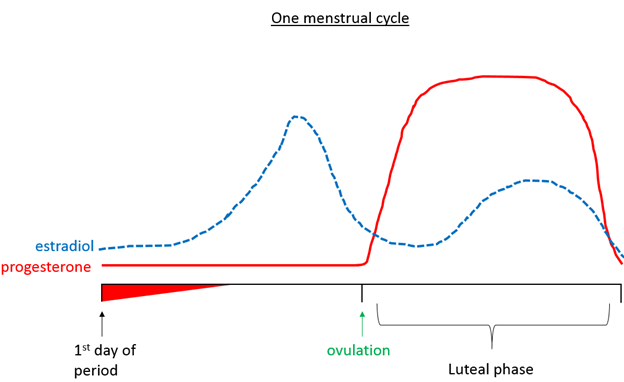
There are two main reasons why hormones become imbalanced, causing PMS:
1. Progesterone drops off too quickly
2. Estrogen is too high
1: Progesterone drops off too quickly
Remember progesterone as the pregnancy hormone – it’s a happy, calming hormone. You produce large quantities of it during pregnancy (I always think of my mum’s description of her happily bouncing down the street whilst 8 months pregnant!).
Progesterone reduces anxiety, boosts thyroid function, hair growth, and is anti-inflammatory. If your hormones are in balance, you feel happy and calm up until your period.
The way to make progesterone is to ovulate. If it is dropping away too quickly, signs of this are spotting towards the end of your cycle and having a short “luteal” phase (the last 10-14 days of your cycle).
To boost progesterone production, you can take magnesium and vitamin B6.
Cravings for chocolate before your period can indicate a magnesium deficiency – cocoa is very high in magnesium! Try an 80%+ dark chocolate, and other sources of magnesium include leafy green vegetables, seaweed, nuts and seeds, having an epsom salt bath or going for a swim in the sea!
Remember it takes 3 months for each follicle to develop into an egg, and so when you start implementing progesterone-boosting tips, give it 3 months to see the results.
2: Estrogen is too high
It is normal to have high estrogen in the first part of your cycle before ovulation – in fact you need this high estrogen in order to stimulate luteinising hormone, which then tells the egg to pop out of the ovary.
However in the second half of your cycle – the “luteal” phase, progesterone should be the dominant hormone.
Excess estrogen specifically can cause water retention, painful/swollen breasts and irritability.
Again, vitamin B6 helps to metabolise estrogen.
Excess estrogen is excreted through the bowels, so ensure you are having 1-3 bowel movements per day, by eating sufficient fibre and drinking enough water.
Also, certain gut bacteria can “re-activate” estrogen which then goes back into your circulation, so having probiotics and cutting down on sugar and refined carbohydrates can also help with minimising these gut bacteria.
Estrogen also stimulates the production of histamine. You may recognise histamine as something that causes seasonal allergies and immune reactions, symptoms of which are a runny nose and streaming eyes.
Other symptoms of high histamine – headaches, anxiety, swelling – are also symptoms of PMS.
You could try a low-histamine diet for one month and see if it helps with your PMS symptoms. (It may also help with period pain).
High histamine-containing foods include: cows dairy, processed or smoked meats and fish, wine, and fermented foods e.g. sauerkraut.
You may be suffering from histamine intolerance if you also have symptoms around ovulation (when estrogen is also high), and if your diet is high in histamine-containing or histamine-stimulating foods.
Summary
I will conclude by saying that the conditions that flare up just before your period are often an underlying issue month-round, e.g. migraines, acne. Delving deeper into why you may be suffering from these conditions specifically and supporting their root cause should also improve your PMS symptoms.
In summary, tips recommended to improve PMS are:
- Magnesium
- Vitamin B6
- Ensuring you are having 1-3 bowel movements a day
- Probiotics
- Cutting down on sugar and refined carbohydrates
- A low-histamine diet
Do you suffer from PMS? What helps you? Let me know what you think in the comments below.